
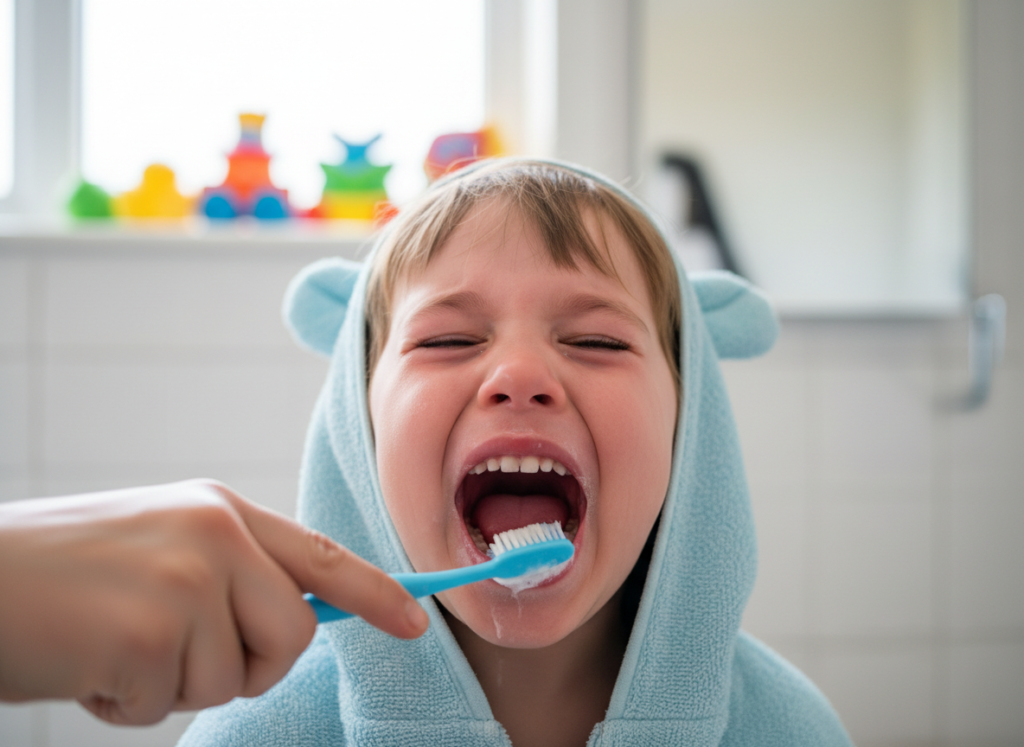
By the time a parent has asked a professional about this issue, they are not asking the question lightly. In fact, by the time the question has been aired to someone else, toothbrushing could well have become a nightly battleground. Whilst most of us would consider tooth brushing to be a simple and relatively straightforward hygiene task, for some, this has turned into negotiation, avoidance, arguments, tears, or outright refusal.
The temptation from this, is to conclude that: she’s being difficult; she’s being lazy; she just won’t listen. However, toothbrushing refusal is rarely about teeth. In this article I hope to explore some of the reasons behind refusal, and offer a few suggestions to get things moving again. The article is not a comprehensive book, just a brief insight into possibilities.
- Tooth bushing is not a small task for a small nervous system
Toothbrushing looks simple to an adult, but it is not simple necessarily for a child. Toothbrushing requires motor coordination, sequencing and planning, tolerance of sensory input, and compliance at the end of a tiring day when regulation is already depleted. Executive function, which can include the initiation of tasks and also planning, develops throughout childhood. Some would argue develops into adulthood. For some children, especially those who are tired, over stimulated, already dysregulated, brushing their teeth will be the one demand that tips complex interactions into full out war.
- Sensory experience matters more than you think
Mint burns. Foam spreads and fills up the mouth. Bristles scraped the gums. Floss can get stuck between the teeth. Electric toothbrushes vibrate loudly inside the skull. For sensory sensitive child, toothbrushing will inevitably feel highly intrusive or threatening. If your child has sensory processing differences, which will include many neuro diverse children, may experience oral care is overwhelming rather than mildly unpleasant. Thus, if your child’s body perceives threat around them common avoidances not stubbornness but simple and straightforward regulation. Sometimes, even changing the toothpaste flavour brush texture can sometimes shift the entire dynamic virtually instantly.
- ADHD and task initiation
For child with ADHD behaviours, they often struggle to initiate low reward tasks. Toothbrushing is certainly one of these low reward tasks. Brushing one’s teeth is hardly exciting, and there are delayed consequences with a minimal immediate payoff. And also, toothbrushing will compete with all the more exciting distractions such as play, screens, imagination and fatigue.
Repeated prompting of your child can quickly escalate into conflict, as you will know, not because the child is necessarily a positional, but because the demand exposes A neurological initiation gap. In these circumstances, in my experience structure helps more than lectures. Visual routines, timers, planners, and also Co brushing comes use friction. Obviously, these strategies are also appropriate for one child developmentally, but not for another developmentally. Most teenagers would run a mile if you started to propose the idea of Co brushing, which is probably a healthy response overall.
- Control and autonomy
control is a thing that will reappear throughout your child’s life. This is absolutely normal. Especially between toddlerhood and adolescence toothbrushing come become a predictable repetitive and non-negotiable within their lives. If a child is becoming hooked in o the excitement of conflict, toothbrushing can then become a perfect opportunity and the perfect arena for asserting autonomy. And let’s face it, these behaviours can trigger huge reactions in you as parents, even the best intentioned and the most calm of parents. We want our child to have perfect teeth, we do not want them to experience toothache and tooth extraction, and we want them to have a set of gnashers that people envy rather than ridicule. A smile, after all, is helpful for positive interactions and avoiding risks of bullying.
However, as soon as the adult response becomes more forceful, and more challenging to the child, the child will often push back harder. And what begins as a straightforward hygiene routine quickly becomes a power struggle. This can look like outright resistance, avoidance, delaying tactics, and sadly physical child on parent violence in certain contexts. When this happens, the task is no longer about teeth but control.
- When shame enters the room
if the situation were not already so fraught and challenging, things will certainly ramp up if brushing becomes associated with the master emotion, shame. If we become critical of our children, disgusted, or gave moral judgement, cooperation can most definitely decrease even further. Shame rarely increases compliance in the long term and actually tends to increase avoidance. Children internalised tone long before they internalise dental consequences.
- So what actually helps?
Firstly, instead of escalating, take a breath and step back. Try to recalibrate yourself, so that you can access your own thinking skills rather than a defensive, threat-detecting response. It might be that you can reduce the sensory load to the child. And this will look like choosing a softer brush, choosing different flavours of toothpaste, and a slower pace to get the teeth brushed. It might be helpful to increase autonomy, and this will look like letting the child choose the brush or the sequence. T
here is another opportunity to externalise structure, and if your child has a daily chart for their activities, you can definitely and usefully include the teeth brushing in this. Consistent timing in my view, is often the key to many of these problematic behaviours, as the brain simply thrives under rhythm and routine. I would also recommend that you help the child to regulate first. Do not demand brushing in peak dysregulation time. This is obvious and makes sense, as you are never going to get a child to brush their teeth when they are in the middle of a distressing tantrum. And finally, it might also be helpful to collaborate, by asking questions such as ‘what makes this hard for you’? Rather than ‘why are you being difficult again’?
And as we are all endeavouring to become more reflective and more capable parents, even if only to be better parents than our parents were, it’s always helpful to ask not how do I make her comply, but is what is his behaviour communicating? Is this fatigue sensory discomfort autonomy anxiety I need for connection toothbrushing is rarely the real problem it is simply where the problem shows up and when we respond to what sits underneath the surface behaviour often resolves itself.
Here are ten parenting myths that might also support your thinking with this complex, highly emotive issue:
1. “If I give in once, they’ll win forever.”
This is fear-based thinking.
Flexibility is not surrender. Children do not become dictators because you chose connection over escalation one evening. Consistency matters. Rigidity does not.
2. “Strong children need strong discipline.”
Children need regulation, not domination.
Firm boundaries are important. But force without relational safety activates threat, not learning. A child in fight-or-flight cannot absorb moral instruction.
3. “If they can behave at school, they’re choosing not to behave at home.”
Home is often the safe decompression zone. Many children hold it together in structured environments and unravel where they feel secure.
Different contexts, different nervous system demands.
4. “Good parenting prevents tantrums.”
Tantrums are developmental. Emotional dysregulation is not proof of poor parenting.
The goal is not zero emotion. The goal is teaching regulation over time.
5. “If I explain it logically, they should understand.”
Understanding is not the same as regulation.
A dysregulated brain cannot process logic. Timing matters more than eloquence.
6. “They’re just doing it for attention.”
Attention is a need, not a manipulation strategy.
When behaviour is attention-seeking, it is usually connection-seeking. The question is not how to extinguish it, but why connection is being sought in that way.
7. “Consequences teach responsibility.”
Only if the child can link cause and effect and is emotionally regulated enough to reflect.
Consequences without reflection produce resentment, not responsibility.
8. “If I don’t control this now, it will get worse.”
Escalation often increases when control tightens.
Control can suppress behaviour temporarily. It rarely builds internal regulation.
9. “My child is being manipulative.”
Young children are not strategic power players. They are trying to meet needs with the skills they currently have.
Manipulation implies calculated intent. Most difficult behaviour is survival strategy.
10. “A good parent doesn’t lose patience.”
Patience is not endless.
Good parenting is not the absence of frustration. It is the ability to repair after rupture.
Children do not need perfect adults. They need adults who can return, reflect and reconnect.
Overall, I hope there is something here that you can take away. This is, in my practice, a fairly common occurrence, especially for children with developmental trauma, so you are not alone. The problem can feel more protracted in adolescence – but I’ll talk more about that soon!