
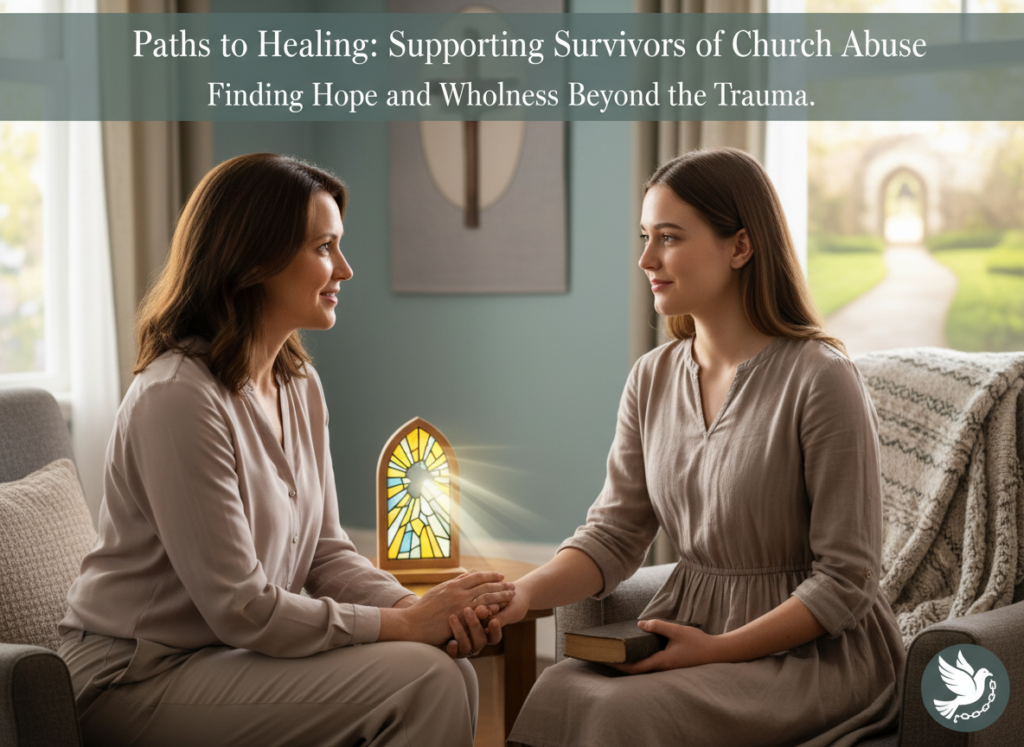
Abstract
Survivors of abuse within religious institutions present with complex trauma profiles shaped not only by interpersonal violation but by institutional betrayal and spiritual injury. This article examines the distinctive clinical features of religious and Anglican-context abuse, outlines core therapeutic challenges, and proposes principles for ethical, trauma-informed psychotherapeutic practice. Particular attention is given to betrayal trauma, moral injury, authority rupture, and the role of institutions in re-traumatisation.
1. The distinctive nature of religious institutional abuse
Abuse occurring within a religious institution differs qualitatively from abuse in non-moralised contexts. Survivors are harmed not only by an individual perpetrator, but by an environment that claimed moral authority, spiritual legitimacy, and protective intent.
In Anglican and similar ecclesial contexts, abuse is embedded within:
- hierarchical authority,
- spiritual teaching,
- moral expectation,
- communal belonging.
This produces a compound trauma, in which psychological harm is inseparable from moral and spiritual violation (Oakley & Kinmond, 2014).
Clinically, survivors frequently report that the abuse destabilised not only their sense of safety, but their capacity to trust meaning, goodness, and authority itself.
2. Institutional betrayal and its psychological consequences
The concept of institutional betrayal is central to understanding survivor presentation. Smith and Freyd (2014) define institutional betrayal as harm occurring when an institution fails to prevent, respond to, or acknowledge wrongdoing within its remit.
In religious abuse cases, institutional betrayal commonly includes:
- disbelief or minimisation of disclosure,
- delayed or opaque processes,
- prioritisation of reputation over protection,
- internal handling rather than statutory referral,
- implicit pressure on victims to remain silent or compliant.
Clinically, this betrayal often produces:
- intensified shame,
- chronic distrust,
- hypervigilance toward authority,
- internalised self-blame,
- relational withdrawal.
Importantly, these symptoms are adaptive responses to a context that proved unsafe.
3. Spiritual injury and moral disorientation
Many survivors describe a rupture not adequately captured by standard trauma frameworks. This is often conceptualised as spiritual injury or spiritual abuse.
Common features include:
- collapse of previously held beliefs,
- loss of spiritual language or imagery,
- confusion between faith and harm,
- fear responses triggered by religious symbols,
- grief for lost community and identity.
While not all survivors retain religious belief, many experience distress at the loss of meaning rather than relief. Therapists who dismiss the spiritual dimension risk replicating institutional invalidation.
Clinical neutrality does not mean spiritual avoidance. It requires respectful engagement with what has been harmed.
4. Presentation in the therapy room
Survivors of institutional religious abuse often present with:
- complex PTSD features,
- dissociation,
- attachment disturbance,
- moral injury,
- authority mistrust,
- heightened sensitivity to power differentials.
Notably, therapists themselves may be unconsciously positioned as authority figures, triggering:
- compliance masking distress,
- delayed disclosure,
- fear of disbelief,
- testing behaviours.
Early therapeutic rupture frequently occurs when survivors perceive:
- subtle defensiveness,
- over-focus on symptom management,
- minimisation of institutional responsibility,
- pressure to forgive or “move on.”
These dynamics must be anticipated rather than reacted to.
5. Therapeutic stance: safety before insight
Effective psychotherapeutic work with this population begins with structural safety, not interpretation.
Key principles include:
a. Explicit power awareness
Therapists must acknowledge the power differential inherent in therapy and name it openly where appropriate. Silence on power often echoes institutional dynamics that harmed the survivor.
b. Credibility is therapeutic
Belief is not a legal conclusion, but disbelief is a clinical intervention. Survivors consistently report that being believed is central to recovery (IICSA, 2020).
c. Pace over productivity
Pressure for narrative coherence or emotional resolution often mirrors institutional demands for closure. Therapy must proceed at the survivor’s pace.
d. Survivor-led meaning-making
The therapist’s task is not to restore faith, dismantle it, or interpret it, but to support the survivor in reconstructing meaning on their own terms.
6. Avoiding re-traumatisation in therapy
Therapy itself can replicate abusive dynamics if not carefully held.
Common clinical risks include:
- privileging therapeutic technique over relationship,
- framing abuse as an individual pathology rather than systemic failure,
- premature focus on forgiveness or reconciliation,
- minimising institutional responsibility,
- pathologising mistrust of authority.
Trauma-informed practice requires recognising that mistrust is often earned, not irrational.
7. Working with anger, grief, and moral outrage
Anger in survivors of institutional abuse is frequently misinterpreted as resistance or dysregulation. In reality, it often represents:
- belated boundary formation,
- moral clarity,
- reclamation of agency.
Similarly, grief may extend beyond personal harm to include:
- loss of community,
- loss of identity,
- loss of spiritual home,
- loss of imagined futures.
Therapy must allow these losses to be named without rushing toward resolution.
8. The therapist’s ethical position
Therapists working with survivors of religious abuse cannot be ethically neutral regarding safeguarding failures.
While therapy is not advocacy, it must not collude with minimisation or institutional narratives that shift responsibility onto victims.
Ethical practice includes:
- understanding safeguarding frameworks,
- knowing referral pathways,
- recognising when institutional processes are harming the client,
- supporting autonomy without isolating the survivor.
In some cases, therapy may be the first environment where truth is spoken without consequence.
9. Implications for training and service provision
Working competently with this population requires:
- training in institutional trauma,
- literacy in safeguarding and abuse inquiries,
- awareness of spiritual harm,
- supervision that explicitly addresses power and countertransference.
Generic trauma training is insufficient.
Institutions that offer therapy to survivors while remaining defensive or opaque risk replicating harm under the guise of care.
Conclusion
Psychotherapeutic work with survivors of religious and institutional abuse demands more than clinical skill. It requires moral clarity, power awareness, and an understanding of institutional harm.
Recovery is not achieved by restoring trust in institutions, but by restoring agency, meaning, and relational safety.
Where therapy succeeds, it does so not by erasing what happened, but by refusing to repeat it.
References (indicative)
- Freyd, J. J., & Smith, C. P. (2014). Institutional betrayal. Journal of Traumatic Stress.
- Independent Inquiry into Child Sexual Abuse. (2020). Anglican Church Investigation Report.
- Litz, B. T., et al. (2009). Moral injury and moral repair. Clinical Psychology Review.
- Oakley, L., & Kinmond, K. (2014). Breaking the silence on spiritual abuse.
- Herman, J. L. (1992). Trauma and Recovery.
- van der Kolk, B. (2014). The Body Keeps the Score.
- Doyle, T. P. (2018). Clericalism: Enabler of clergy sexual abuse.