
Welcome New Subscribers!
Exciting times for the DoctorAndrewSmith brand, and for the people showing an interest in what he has to say.
Living in Divisive Times. Choosing Connection Anyway.
We are living in an age of fracture.
Coming back in to work today, I realised how difficult it is living around so much fracture in the world. Not just politically or culturally, but relationally. Families split over opinions. Friendships thin out. Conversations become performances. People retreat into camps, identities, and certainty because uncertainty feels unbearable.
What is striking is not disagreement. Human beings have always disagreed.
What is striking is how quickly disagreement now turns into dehumanisation.
If someone thinks differently, they are not just wrong. They are suspect. Dangerous. Written off.
This is not strength. It is a nervous system under strain.
When people feel overwhelmed, unheard, or unsafe, they simplify the world. Nuance disappears. Listening feels like a threat. Certainty becomes a form of self-protection.
In therapy, I see this constantly. Not as ideology, but as physiology. People are tired. Overstimulated. Carrying grief they have not metabolised. Carrying fear they have not named. Carrying anger that has nowhere to land.
And when those things are unworked, they leak into everything.
The temptation in divisive times is to pick a side and harden. To curate your world so you never have to encounter challenge, complexity, or difference. That can feel relieving in the short term. It is corrosive in the long term.
Because human beings do not heal in isolation.
And they do not grow through echo chambers.
Connection does not mean agreement. It means contact.
It means the capacity to stay present with another human being without needing to dominate, convert, or withdraw. It means tolerating discomfort long enough to discover that the other person is not a symbol or a threat, but a person with a nervous system, a history, and a story.
This is harder than it sounds.
Real connection requires emotional regulation. It requires humility. It requires the willingness to be changed, even slightly, by encounter.
Most people say they want connection. Far fewer are willing to do what it costs.
In divisive times, connection becomes a discipline.
It looks like slowing conversations down rather than escalating them.
It looks like listening without rehearsing your reply.
It looks like holding your values without turning them into weapons.
It looks like choosing curiosity over certainty, especially when certainty feels safer.
This does not mean tolerating harm or abandoning boundaries. Connection is not passivity. It is strength with permeability.
One of the quiet tragedies of our time is how many people feel lonely while surrounded by opinions. How many feel unseen while constantly broadcasting. How many feel disconnected while technically “in touch” all day.
Connection is not information exchange. It is presence.
And presence is increasingly rare.
If there is a task worth taking seriously right now, it is this: learning how to stay human with one another when the world encourages us not to.
That work begins internally. With noticing where you harden. Where you withdraw. Where you simplify others to protect yourself.
And it continues relationally. In conversations that are slower, deeper, and less performative. In spaces where people can speak without being flattened into labels. In relationships where difference does not automatically mean danger.
This is not glamorous work. It does not trend well. But it is essential.
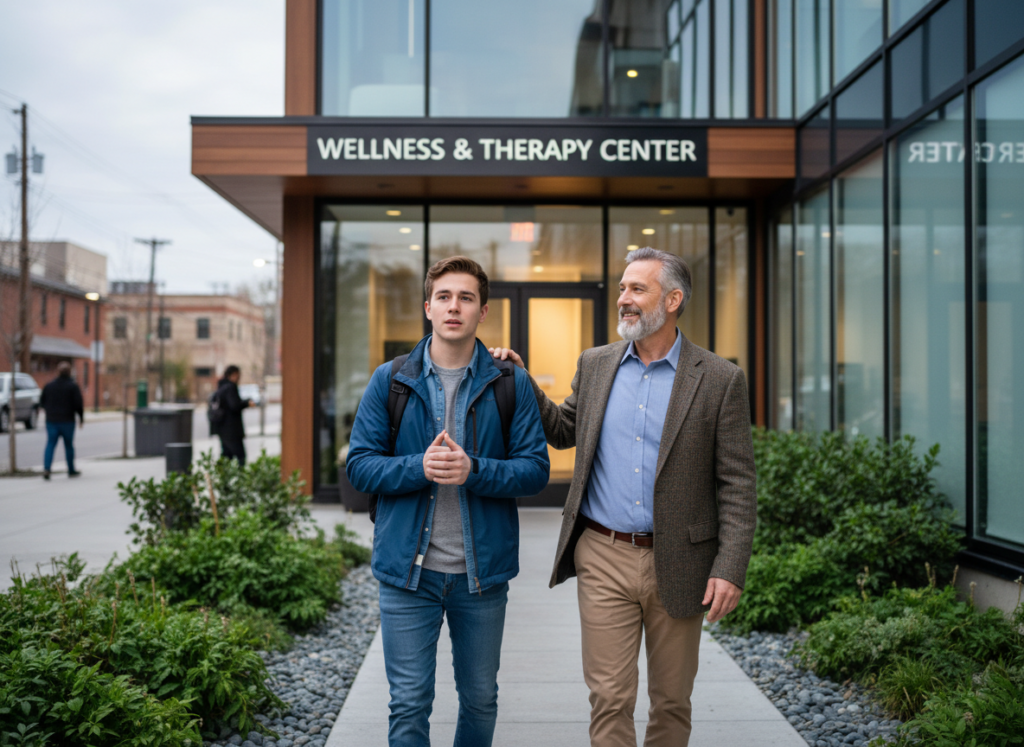
In divisive times, connection is not naïve. It is radical. And remember, men, it’s ok to go in to therapy, not for anyone else but yourselves!
Andrew